Jim Hodges

Associate Professor, Division of Biostatistics, University of Minnesota

WOC Statistician, Center for Chronic Disease Outcomes Research, Minneapolis Veterans' Affairs Medical Center

Statistician, Minneapolis Heart Institute Foundation

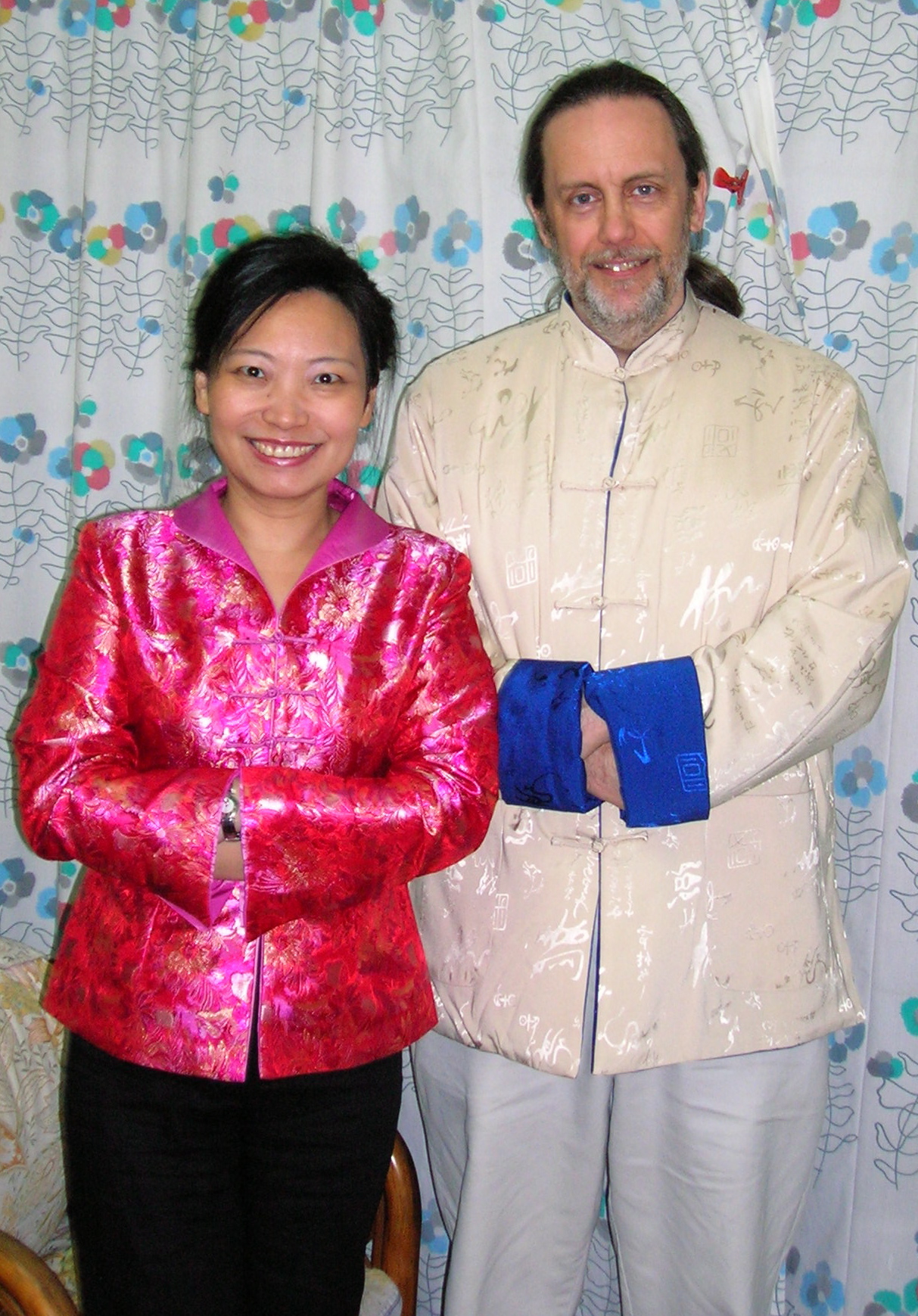
I'm the one on the right. The one on the left is Li Chi-ping, who became my bride on 13 February 2007. (Photo taken March 2006, Taipei).

My various locations

Main location: U of Minnesota Division of Biostat

  • Division of Biostatistics
  • School of Public Health
  • University of Minnesota
  • 2221 University Ave SE, Suite 200
  • Minneapolis, Minnesota 55414
  • Phone (612) 626-9626, Fax (612) 626-9054
  • e-mail: hodges@ccbr.umn.edu, hodge003@umn.edu (they go to the same inbox)

    At the Veterans' Affairs Medical Center

  • Center for Chronic Disease Outcomes Research
  • One Veterans Drive
  • Minneapolis, MN 55417
  • Phone (612) 467-3876
  • e-mail: james.hodges@med.va.gov
  • [NOTE: I am at the VA only on Mondays and Thursdays and do not read my e-mail there on other days.]

    At the Minneapolis Heart Institute Foundation

  • Minneapolis Heart Institute Foundation
  • 920 E 28th St
  • Minneapolis, MN 55407
  • phone (612) 863-1626
  • e-mail: JimHodgesMHIF@gmail.com
  • [NOTE: I am at MHIF only on Tuesday and Friday afternoons and generally don't check this e-mail account on other days.]

    Curriculum Vitae (or whatever "CV" stands for)

    Having trouble sleeping? Take a look at Jim's vita, current as of 24 April 2008.

    Materials for PubH8400/02 Spring 2008 "Richly Parameterized Models".

    Official syllabus

    Detailed syllabus, revised 2/18/08.

    Suggestions for class projects updated version 3/10/08.

    Papers assigned as reading

  • Cui, Hodges, Carlin (2007)
  • Hodges (1998)
  • Hodges, Cui, Sargent, Carlin 2007 published version;
  • Peterson et al 2001
  • Reich and Hodges 2007
  • Reich et al 2007 JASA version, page proofs; Research report version, rr2004-004
  • Reich et al 2006.
  • Reich & H, Spatially-adaptive CAR paper, Feb 2007 version

    Transparencies used in lectures; labels for files refer to the detailed syllabus.

  • Part I, Section A, 1, 2a (through conventional analyses) here; error on page IA1/13
  • Part I, Section A, 2b, 3, 4 (through the end of IA) here
  • Part I, Section B (alternative formulation; measures of complexity) here updated 1/30/08, replaced version posted 1/28/08
  • Part I, Section B thesis topics, Section C here
  • Part I, Section D except discrete-by-discrete interactions here
  • Part I, Section D, discrete-by-discrete interactions (smoothed ANOVA) here
  • Part I, Section E, spatial smoothing 1 (CAR smoothing on a lattice) here
  • Part I, Section E, spatial smoothing 2 (2D penalized splines) here
  • Part I, Section F, time series (dynamic linear models, Kalman filter-style models) here
  • Part II, Section A, Simple extensions of linear-model diagnostics here
  • Part II, Section B, Collinearity/Confounding and Smoothing/Shrinkage (beginning) here
  • Part II, Section B, Collinearity & smoothing (CAR smoothing) here, revised 3/7/08
  • Part II, Section B, concluded; Section C (identification of parameters in the variance structure) teaser here
  • Part II, Section C, identification of parameters in the variance structure, oddities here, sorry about the poor quality of the copies; all of the pictures that copied poorly are in the research-report version of Reich et al 2007.
  • Part II, Section C, identification of the parameters in the variance structure, Reich & Hodges 2007 here
  • Part II, Section C, previous continued; R&H 2007 for CAR model; 3-variance models here
  • Part II, Section C concluded, CAR models with 2 classes of neighbor pairs here
  • Part II, SPECIAL EXTRA, Random effects in the analysis vs random effects in data generation: lecture transparencies; there's also a draft paper covering the same ground more explicitly (or at least, using more words).
  • Part II, Section D, Influence of a few "observations" on variance-structure unknowns here
  • Part II, Section D, Generalizing last class's r-hat_i so z_i; applying the result to a spatio-temporal model for attachment loss here
  • Part II, Section D, a better spatio-temporal model, z_i still applies here
  • Part II, Section E, two last oddities from real datasets (oddities I wish someone had shown me) here

    Homework assignments

  • #1, 1/29/08 error in question 2
  • #2, 2/5/08
  • #3, 2/12/08
  • #4, 2/19/08

    Datasets

  • Molecular structure of a virus
  • Vocal folds
  • Global mean surface temperature deviations (in 0.01 degrees C) Text file, Excel file.
  • Physical properties of pig jawbone Excel file
  • Soft material polishability data -- as in Appendix B of Hodges et al 2007 -- columns are not scaled! Excel file

    Papers you can download

  • A postscript version of Sargent DJ, Hodges JS, Smoothed ANOVA with application to subgroup analysis, submitted to JASA some years ago and rejected with enthusiasm. A completely reworked and much better version has been accepted by Technometrics; the Research Report version is rr2005-018 on the U of MN Biostat web site.

  • A postscript version of Hodges JS, Sargent DJ, "Counting degrees of freedom in hierarchical and other richly parameterized models". The original version has some interesting stuff that's not in the Biometrika version (Hodges JS, Sargent DJ. Counting degrees of freedom in hierarchical and other richly-parameterised models. Biometrika, 88:367-379, 2001).

    Items associated with "Some algebra and geometry for hierarchical models, applied to diagnostics" (JRSSB 1998)

    Dataset: This dataset is in ASCII format. The file containing the dataset has two matrices -- one for plan-level data and one for state-level data -- and some introductory material.

    S+ functions: Peiming Ma has written S+ functions to execute the analyses in this paper. You can get separate postscript files for: documentation 1 and documentation 2, and ASCII files containing the functions for: gibbs sampler, trace plots, added-variable plot, collinearity check, case influence, residuals, and transformations. Although we have tested these functions and they work as far as we know, USE THEM AT YOUR OWN RISK! Also, we make no claims to efficiency or exemplary programming style, but they do appear to work.


    Last updated: April 2008.


    Return to U of M Biostat home page.


    Official Disclaimer: The views and opinions expressed in this page are strictly those of the page author. The contents of this page have not been approved by the University of Minnesota.

    Unofficial Disclaimer: This is all my fault. The U is blameless. They're such nice people, how could you even think of blaming them! Shame on you!